Additional utility data
The files mentioned in the previous sections refer to monthly, daily, and hourly consumption/SCADA data required for Temetra Analysis to perform water balance and additional analytics calculations. Temetra Analysis also requires some additional information from the utility to perform water balance calculations. This information is required per DMA or zonal area and will be used by the Itron delivery team to set up the tenant within the application.
|
Requirement |
Used by |
|---|---|
|
Number of connections |
CARL/UARL calculation |
|
Network length |
CARL/UARL calculation |
|
Average pipe length |
CARL/UARL calculation |
|
Average meter age |
Water balance and CARL/UARL |
|
Average pressure |
|
|
Average tariff rate |
Water balance and KPIs |
|
Average operating cost |
Water balance and KPIs |
|
Supply type |
Water balance and KPIs |
|
Target ILI |
Water balance and KPIs |
|
Maximum pressure allowed in DMA |
Water balance and KPIs |
|
Minimum pressure allowed in DMA |
Water balance and KPIs |
|
Percent of time system fully pressurized |
Water balance and CARL/UARL |
|
QLI |
Water balance (daily/monthly data granularity) |
|
QCI |
Water balance (daily/monthly data granularity) |
|
FND |
Water balance (daily/monthly data granularity) |
|
N1 |
Water balance (granularity: all) |
The requirements are defined as follows:
-
Number of connections. The number of metered and unmetered connections within the DMA.
-
Network length. The total length of pipe network leading up to but excluding service line connections.
-
Average pipe length. The average service line connection length.
-
Average pressure. The median working pressure at which the utility expects the DMA to operate. This value is used by the hydraulic models and pressure-tracking algorithms to determine whether the water system's pressure is within the expected working range.
-
Average meter age. The average age of the population of monitored water meters within the DMA.
-
Average tariff rate. The average selling price to the consumer for a standard measure of water (such as 1m3, 1000 gallons) within the DMA.
-
Average operating cost. Also known as Variable Production Cost. The average operating cost for the utility to pump, clean, and supply water to the DMA, typically measured as cost per megaliter or cost per mega gallon.
-
Supply type. Indicates whether the water entering a DMA is water pumped or gravity fed.
-
Target ILI. The utility's target Infrastructure Leakage Index for each DMA.
-
Maximum pressure allowed in DMA. The maximum allowable working pressure within the DMA. This is the maximum working pressure that the water network can experience without exceeding safety limits.
-
Minimum pressure allowed in DMA. The minimum allowable working pressure within the DMA. This is found at the critical point, which is the geographic location where the minimum allowable working pressure can be observed.
-
Percent of time system fully pressurized. The Temetra Analysis solution is designed for a system for which water pressure is constantly maintained. However, for utilities with intermittent water conditions, Temetra Analysis can calculate the water balance under certain circumstances.
-
QLI. If daily or monthly consumption data is provided, the average nighttime consumption per connection is required for the water balance calculation. This measure is typically performed by logging hourly consumption over a one-week period for a random selection of residential consumers. Example of typical behavior:
Nighttime consumption period: 12:00 AM – 4:00 AM
Average nighttime consumption taken over 20 residential connections: 0.0049 m3/h (2 gal/hr)
-
QCI. If only daily or monthly consumption data is provided, the average nighttime consumption per commercial and industrial (C&I) connections is required for the water balance calculation. This measure is typically performed by logging hourly consumption over a one-week period for a random selection of C&I connections. Example of typical behavior:
Nighttime consumption period: 12:00 AM –4:00 AM
Average nighttime consumption taken over 10 C&I connections: 1 m3/h (300 gal/hr)
-
FND. Also known as Night-Day Factor, this is used to indicate the leakage throughout the course of a day (24-hour period), derived with the following formula:
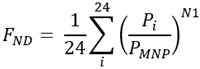
Where:
Pi = Pressure at hour i (1–24)
PMNP = Pressure during the Minimum Night Period (typically 2 AM–4 AM)
N1 = Leakage Exponent (the amount by which the system leaks during the Minimum Night Period)
Note: The FND value is typically in the range of 16–25, with a typical value of 22.
-
N1. The Leakage Exponent value, obtained by the utility by evaluating/sampling the flow and pressure drop in a closed DMA when flow to the DMA is restricted over a period of nighttime hours. This test is repeated over a period of several days. The calculation is typically performed when the DMA is initially set up, when monitoring for water balance calculations need to be performed, or under one of the following conditions:
- Large water network changes have taken place (for example, new construction within the DMA).
- A large leakage campaign has been implemented, and indicators from the water balance calculation indicate a growing incorrect split between real and apparent losses.
N1 method
Before the actual measurements are taken, the following criteria should be met:
-
The DMA or zonal area to be evaluated for the N1 calculation needs to be fully closed. All outflow points should be temporarily closed.
Note: It is possible to keep the bulk DMA outlets open, but high-granularity interval logging must be enacted to minimize any effects on the N1 calculation (1–5 minute recording interval).
-
The DMA to be tested should have a valve that can be closed at the bulk inlet to the DMA.
-
A pressure logging device is located at the critical point with hourly or sub-hourly recording installed and active.
-
A logging device is present to capture bulk flow at the inlet to the DMA.
-
Using logging devices to monitor bulk inlet flow and pressure at the critical point (minimum pressure point), determine a monitoring time window when flow and pressure are at their most stable. Flow should be at a minimum. Typically, a stable window period is around minimum night flow when flow does not increase above the minimum night flow value by more than 10%.
-
All large consumers should be requested not to use water during the test period. Alternatively, hourly or sub-hourly logging devices for monitoring flow should be installed at premises so that their consumption can be subtracted from the bulk inlet flow during the actual hours when these tests are performed.
See also N1 test.