ResponseBase
IEE services all return a single response element, and in most cases this element inherits from ResponseBase.
The following illustration shows the ResponseBase element schema:
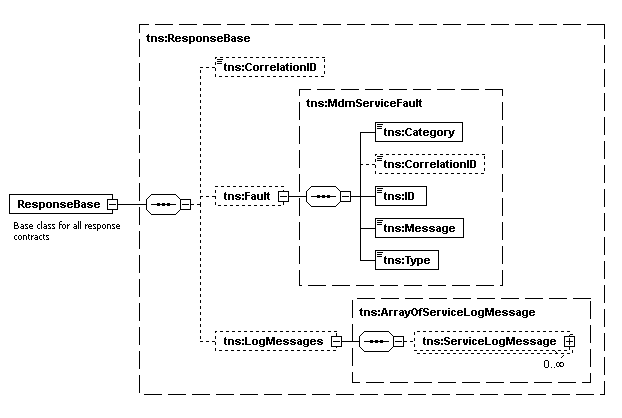
The following is a list of ResponseBase elements:
-
CorrelationID. Gets or sets a value that can be used to correlate a request, response, and/or fault. This property is used to match a request and a response.
-
Fault. Fault information that is returned in the service operation fails. If a fault occurs, it is returned in element only if the ReturnFaultInResponse element in the request is set to True. Otherwise, the fault is returned as a SOAP fault.
-
Category. The category of the fault. Faults are grouped into general categories such as "IDNotRecognized."
-
CorrelationID. The CorrelationID that was passed in the request is reflected in this element. This is useful then the fault is returned as a SOAP fault.
-
ID. Identifies the message.
-
Message. The text of the message.
-
Type. The general type of fault. The valid values are as follows:
-
AccessViolation. A security error occurred.
-
InvalidParameter. The request failed initial validation.
-
ApplicationException. A business logic error occurred.
-
SystemException. A system problem occurred (for example, a database error).
-
LogMessages. A collection of ServiceLogMessage elements. ServiceLogMessages are messages of varying severity that are logged during the execution of the service call.
ServiceLogMessage has the following sub-elements:
-
Category. The category of the message. Messages are grouped into general categories such as "IDNotRecognized."
-
ID. The specific identifier of the message.
-
Message. A text description of the message.
-
Severity. The severity of the message. Possible values are CriticalError, Error, Warning, Information, Debug and Trace.
-
Source. Indicates the subsystem where the message originated.