Log event publishing
IEE log event publishing fits into a typical queuing architecture by providing a set of messages that are usable by external systems. The messages enable external systems to monitor the health of the application, to be notified when work is complete, and to be alerted to certain conditions that may require initiation of other workflows.
Because the log event publishing implementation is generic to many of the messages that IEE can log, the uses are varied and can be different from one customer implementation to the next.
It should however be noted that regardless of customer implementation:
-
While IEE can log trace and debug messages to log files, these messages are never written to MSMQ.
-
Because the MSMQ log event publisher was added to the IEE logging service, only those messages that are routed through the logging service, and which have a TaskID are capable of publication.
-
Because the IEE rich client does not run tasks, very few messages that originate in the rich client are eligible for log event publication.
IEE fits into the workflow as shown in the following illustration. IEE is shown as a rich client application that can log messages, an application server that can log messages, or messages can be logged by the Web services that are hosted by IEE. Messages can be routed to other applications, dashboard tools, monitoring utilities, security alerts, or any other work flows that rely on messages between systems.
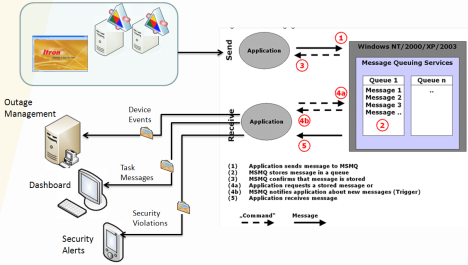
Because IEE logs many different types and severities of messages, a selection mechanism that enables users to select messages of interest is required. The selection mechanism must be capable of the following:
-
Log specific messages
-
Log messages according to category
-
Log messages according to severity
-
Send certain categories or message IDs to specific queues