How it works
The Advanced Transformer Load Monitoring application computes and monitors the transformer-level
This version of Advanced Transformer Load Monitoring is designed for a greenfield population. A greenfield population is defined as one in which all the meters are Distributed Intelligence Network Adapter (DINA)-enabled Riva meters.
Advanced Transformer Load Monitoring requires the Location Awareness application to be licensed, configured, and running. The Location Awareness application's agent pushes information to the ActiveTransformerMonitoring agent. The ActiveTransformerMonitoring agent analyzes the metrology data from the meter. The ActiveTransformerMonitoring agent sends the data to the Advanced Transformer Load Monitoring application where the data is collated and the application displays the data. From all the meters on that transformer, the ActiveTransformerMonitoring agent is aggregating what the actual
The data is broadcast by the agent over power-line carrier (PLC) every minute. There is a programmable on‑accumulation period during which the agent waits to receive all the meters' data before it sends that data to the back office. The data that gets sent up to the Connected Grid Router (CGR) is timestamped for the period during which that data was sent by all the meters. It is not the date time that the data was received by the reporting meter.
In the case of PLC communication problems, there may be islands of meters that can communicate between themselves. In this case, each of the reporting meters reports aggregated data for a subset of the meters that are owned by the reporting meter. This requires additional aggregation on the back end to find the total usage on the transformer.
Data process
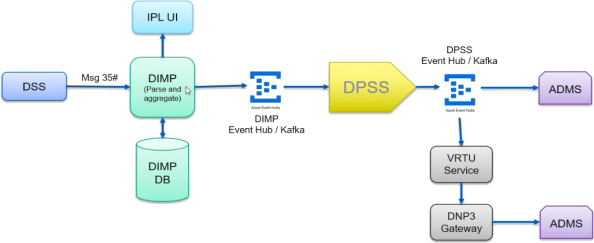
The data is sent from the agents to the collection system.
The collection system sends it through the On-Premises Hybrid Service (OHS) to a DI subscription service (DSS).
The DSS processes the data and reports the real time data to the Distributed Intelligence message processor (DIMP). DIMP subscribes to DSS and receives all messages.
DIMP receives the data and looks in the database for transformer information such as transformer capacity. If there are multiple reporting meters, DIMP aggregates the data. Multiple reporting meters may cause a delay because the application will wait to hear from all reporting meters before aggregating the data.
The data is sent to a Kafka queue.
From the Kafka queue, the data becomes available on the data product subscription service (DPSS) and the data is available for utility subscriptions. The utility can subscribe directly to the Kafka queue, from which they will receive streaming data in near real-time. Another approach is to have a virtual remote terminal unit (VRTU) service and a DNP 3 Gateway that can also publish the data to the utility's advanced distribution management system (ADMS).
The maximum latency for data to appear in the application is five minutes. The RealTimeDataMaximumLatencyNumberPeriods parameter configures how long the DI message processor will wait to hear from reporting meters before publishing the data. If the data sent to the application does not include data from all reporting meters, the data quality will be flagged as Low. If the data sent to the application does include all the reporting meters, the data quality will be flagged as High.